
A citation reaches court without an underlying opinion. A chatbot promises a fare exception the airline disputes. The records below show where an unsupported answer crossed into a consequential decision. Each account links to the evidence we could actually inspect.
What can you download?
Version 1.0 · October 13, 2026 · 2 verified records. Download the CSV, JSON and data dictionary and reuse notes. Both formats contain the same incident IDs, dates, organizations, consequences, response records, sources and proposed controls.
How to cite Hallucination-Free. The Hallucination Tracker, version 1.0, October 13, 2026. https://www.hallucination-free.org/tracker/ (include your access date). Original summaries and compilation: CC BY 4.0. Credit Hallucination-Free, link this page and the license, and identify changes. The license does not relicense linked court records, contributor portraits or site artwork.
Which incidents are included?
HF-001 · Mata v. Avianca: fabricated authorities in a court filing
Event: 2023-03-01 · Filing date identified in the court order; not the date of model generation. Organization: Levidow, Levidow & Oberman P.C..
System: ChatGPT, as identified by the court; version not verified.
What happened: The court describes nonexistent opinions, with fabricated quotations and citations generated by ChatGPT, being submitted and then defended after their existence was questioned.
Documented impact: The court required production of the cited opinions and issued a show-cause order. This record does not quantify sanctions because the disposition was not accessible in this review.
Response record: The court records that respondents stood by the opinions after judicial orders questioned them. A separate case-specific firm or developer statement was not verified; the court account is not a direct statement from them. Read the response evidence.
Proposed prevention control (editorial analysis): A filing gate requiring a reviewer to retrieve each original authority and verify its quotation and proposition would reject citations that cannot be substantiated. An unresolved authority must block filing; a generated assurance is not evidence.
Primary record · Reviewed 2026-10-13. Substantive indexed opening only; complete opinion and disposition not retrieved.
HF-002 · Air Canada: chatbot advice contradicted the fare policy
Event: 2022-11 · Month of chatbot interaction; tribunal decision dated 2024-02-14. Organization: Air Canada.
System: Website chatbot; model and architecture not established by the passages reviewed.
What happened: The tribunal describes a chatbot advising that bereavement fares could be requested retroactively, followed by employees saying they could not. The passenger sought the fare difference.
Documented impact: The tribunal mostly allowed the claim and found Air Canada had not taken reasonable care to ensure chatbot accuracy. The award amount was not recoverable and is not reported here.
Response record: The decision records Air Canada denying liability, disputing retroactive eligibility and seeking dismissal (paragraph 4). Paragraph 22 records a company response acknowledging misleading chatbot wording. Read the response evidence.
Proposed prevention control (editorial analysis): Generate fare eligibility from a versioned approved policy decision, and prevent unsupported prose from promising an exception. Conflicting advice should route to review before the traveler relies on it. This is a proposed control, not a finding about the unknown chatbot implementation.
Primary record · Reviewed 2026-10-13. Tribunal decision on third-party host. Indexed heading and paragraphs 1–11 plus recovered same-document passages 22 and 28; complete order unavailable.
What does this small release show?
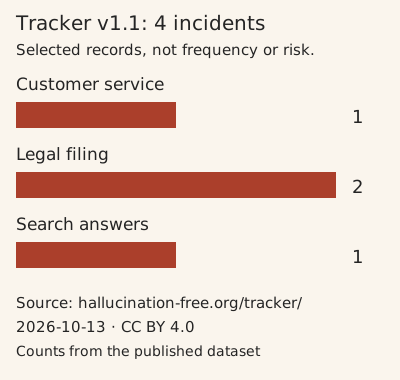
These bars count records in this release, not the frequency or risk of hallucinations in either sector. One case can generate multiple articles or court documents; we count the underlying incident once. We do not turn this selected archive into a trend line or compare model accuracy from it.
How do we verify and classify a record?
We include an incident only when a readable primary record establishes the unsupported output and its use or consequence. A link alone is insufficient. Readable indexed passages can support a narrowly scoped record; the access field tells you when the complete document was unavailable. These two records describe court or tribunal findings, not a reproduction of the original system.
The term hallucination here covers invented authorities and unsupported factual or policy assertions. That editorial category does not identify the technical cause. In particular, the Air Canada passages reviewed do not establish a model or architecture; this dataset does not label it an LLM failure.
Stable IDs survive corrections. The event date describes the documented interaction or filing, while the date-basis field distinguishes it from a later decision. A missing amount is unknown, never zero. Response fields separate a company’s recorded position from a statement we have not verified. Prevention fields are our analysis, not the adjudicator’s prescription or a promise of perfect prevention.
The initial leads came from research supplied by Kognitos (publisher of this site). The summaries above were checked against the linked primary documents; the supplied archive’s category totals are not the dataset’s incident count. Read our editorial policy.
How can a team use these records?
Turn the documented failure into a test. For fabricated authorities, require an original record that supports the exact claim; an unresolved citation should fail the gate. For policy advice, test whether unsupported wording can override the approved policy decision. Retain the failure result and the evidence checked.
Use the citation verification guide, the Mata Case File and the prevention guide for more detail. For reproducible execution and review records, use the companion Deterministic AI Checklist. Repeatability and factual support require separate evidence.
What changed in this release?
- 2026-10-13 — v1.0: published HF-001 and HF-002, CSV/JSON, field definitions, reuse license, citation guidance and a chart of included contexts. Amounts absent from accessible dispositions are deliberately omitted.
Corrections will identify the affected record, the changed field, supporting evidence and release date here. New records will be added after source verification; there is no automatic ingestion of unverified reports.
Frequently asked questions
Is this a list of every AI hallucination incident?
No. Version 1.0 contains two selected incidents with primary records we could read. It is neither exhaustive nor a representative sample.
Can I reuse the dataset?
Yes. Our original summaries and compilation are licensed CC BY 4.0. Credit Hallucination-Free, link the Tracker and license, and identify changes. Linked documents have their own terms.
Do the proposed controls prove an incident would have been prevented?
No. They identify a review or execution boundary that could block the documented failure. Their implementation and effectiveness require testing.
The source record
Read the original evidence and the scope of our review.
- Mata v. Avianca: Opinion and Order on SanctionsU.S. District Court, Southern District of New York; copy hosted by District of Connecticut · 2023; full order date not recovered in this read · Accessed 2026-10-13Substantive indexed opening only; complete opinion and disposition not retrieved.
- Moffatt v. Air Canada, 2024 BCCRT 149British Columbia Civil Resolution Tribunal; third-party-hosted copy · 2024-02-14 · Accessed 2026-10-13Tribunal decision on third-party host. Indexed heading and paragraphs 1–11 plus recovered same-document passages 22 and 28; complete order unavailable.